 Scramble
Guides Using ScrambleBoard
Golf words in plain English
You do not need to play golf to run a golf event. This page explains every golf word the guides use, in plain words. In any guide, a word with a dotted underline links here.
A hole and a round
A golf course has 18 holes (some have 9). On each hole, a player hits the ball from a starting area to a small cup on the putting green, and counts every hit. One hit is one stroke. A round is all 18 holes, which takes about four to five hours.
Par
Par is the number of strokes a good player needs on a hole: 3, 4 or 5. The par of the whole course is the total of its holes, usually 72. Scores are often shown against par: "+2" means two strokes more than par, "-1" means one stroke less, and "E" (even) means exactly par.
Birdie
One stroke less than par on a hole. A 3 on a par 4 is a birdie.
Eagle
Two strokes less than par on a hole. A 3 on a par 5 is an eagle.
Albatross
Three strokes less than par on a hole, also called a double eagle. It is very rare.
Bogey
One stroke more than par on a hole. A 5 on a par 4 is a bogey.
Double bogey
Two strokes more than par on a hole. A 6 on a par 4 is a double bogey.
Gross and net
The gross score is the strokes a player really took. The net score is the gross score less the player's handicap strokes. Net scoring lets players of different skill compete fairly. An event can rank by gross, by net, or show both.
Handicap index
A handicap index is a number that shows how good a golfer is: the lower the number, the better the player. A beginner can be 30 or more; a very good player is near 0. Players who belong to a club get an official index from their golf association (in the US, through GHIN). ScrambleBoard also takes an index you type in.
Course handicap and playing handicap
A course handicap is the index changed to fit one course and one set of tees, because some courses are harder than others. The playing handicap is the course handicap after the event's allowance. The playing handicap is the number of handicap strokes a player gets in the event. ScrambleBoard calculates both for you.
Handicap strokes (dots)
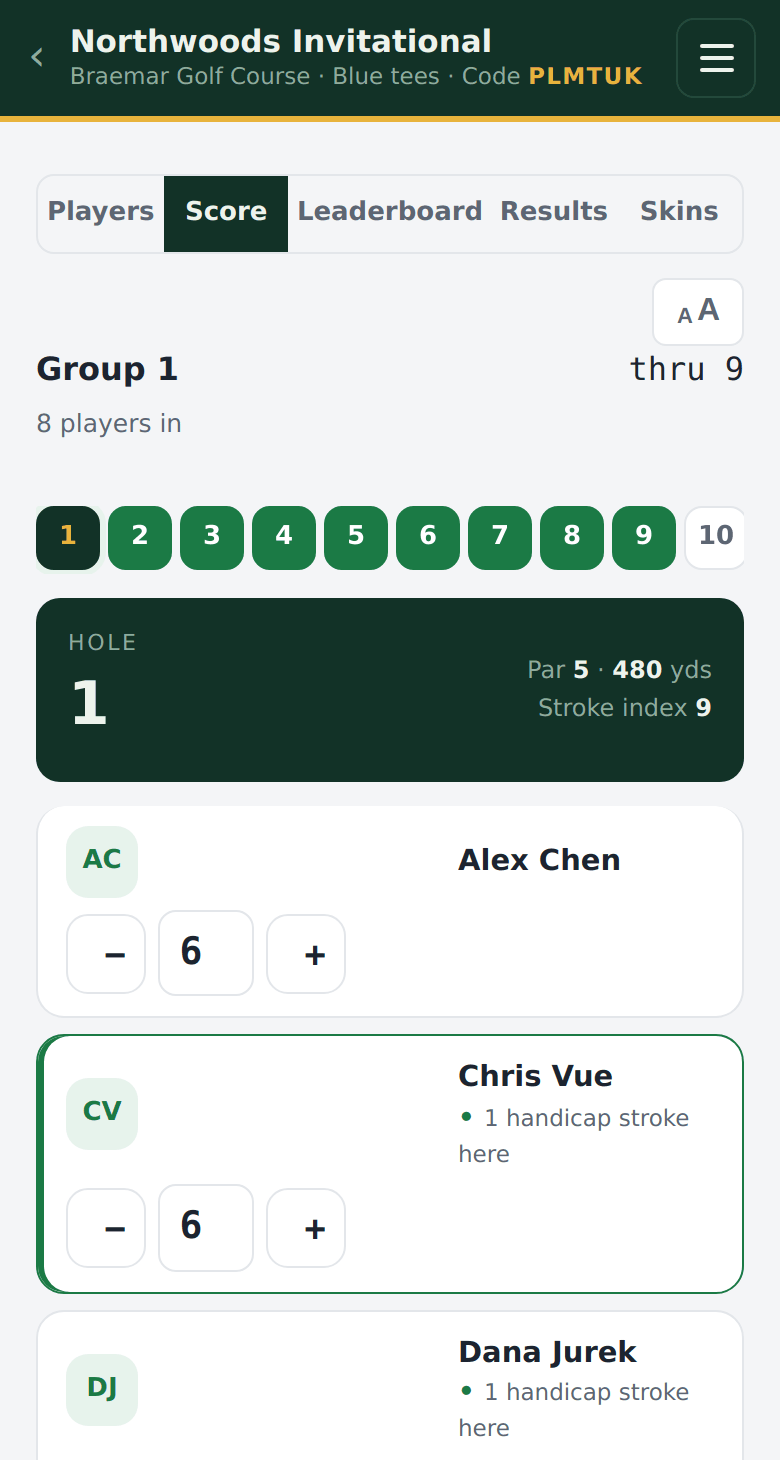
A handicap stroke is one stroke taken off a player's score on one hole. A player with a playing handicap of 10 gets one stroke on each of the 10 hardest holes. The scorecard marks each one with a dot: on a hole with a dot, the score counts one less. Two dots mean two strokes.
Handicap allowance
The share of a handicap a player gets in a format, for example 85% in a four-person team event. The allowance keeps team formats fair, because a team already gets the best of several shots.
Stroke index
Every hole has a stroke index from 1 to 18 on the scorecard. Index 1 is the hardest hole, and 18 the easiest. Handicap strokes go on the holes with the lowest index first.
Slope and course rating
Two numbers on the scorecard that tell how hard a course is from one set of tees. The course rating is the score a very good player expects. The slope tells how much harder the course is for an average player. You do not need to calculate with them: ScrambleBoard reads them from the course data.
Tees
The tees are the starting areas on each hole. A course has several sets of tees at different distances, often named by color (blue, white, red). Players pick the set that fits their skill, and each set has its own slope and rating.
Tee time
The time a group starts its round. In a tee-time start, groups go out one after another from hole 1, about 10 minutes apart.
Shotgun start
Every group starts at the same time, each on a different hole. When the round ends, everyone finishes together. Most charity events use a shotgun start. Because groups start on different holes, the leaderboard shows how many holes each one has played (see Thru).
Front nine and back nine
The front nine is holes 1 to 9, the back nine is holes 10 to 18. Some events and leagues play only nine holes.
Scramble
A team format. Every player in the team hits, the team picks the best shot, and every player hits again from that spot. The team writes one score per hole. Scrambles are fast and friendly to beginners, which is why most charity events use them.
Best ball
Every player plays their own ball, and the team's score on a hole is the best score in the team. Some events count the best two or three scores on each hole.
Four-ball
Best ball for teams of two: both players play their own ball, and the better score counts. It is a common format for match play and member-guest events.
Foursomes (alternate shot)
Two partners play one ball and take turns hitting it. One partner hits the tee shots on the odd holes, the other on the even holes.
Shamble
A mix of scramble and best ball. The team picks the best tee shot, then every player plays their own ball from there to the hole.
Stroke play
Count every stroke over the whole round. The lowest total wins.
Match play
Two players or two teams play against each other hole by hole. The lower score wins the hole. The leader is "up" by the number of holes they lead, and the match ends when one side leads by more holes than are left to play.
Stableford
A points format. A player earns points on each hole for the score against par (for example 2 points for a par, 3 for a birdie, 0 for a double bogey or worse). The most points wins.
Quota
A points format where each player gets a target (a quota) from their handicap. The winner is the player who beats their own target by the most points.
Skins
A side game. Each hole is worth a prize (a skin). A player who wins a hole alone takes the skin. When players tie, nobody wins the skin, and it carries over to the next hole.
Carryover
A skin that nobody won because of a tie. It adds to the prize of the next hole.
Closest to the pin and long drive
Two contests on chosen holes. Closest to the pin goes to the tee shot that stops nearest the hole on a par 3. Long drive goes to the longest tee shot that stays in the short grass (the fairway).
Flights
Groups of players with similar handicaps who compete for their own prizes, for example an A flight for the best players and a C flight for beginners.
Mulligan
A do-over: the player hits a shot again and plays the better one. Charity events often sell mulligans to raise money.
Calcutta
An auction before the event. People bid on players or teams, the bids make a pot, and the bidders who bought the winners share the pot.
Nassau
A bet in three parts: the front nine, the back nine, and the whole 18. Each part is a separate bet.
Countback
A way to break a tie: compare the scores on the last 9 holes, then the last 6, the last 3, and the last hole, until one player is better.
GHIN
The Golf Handicap and Information Network, the US system that keeps official handicap indexes. ScrambleBoard does not need a GHIN connection: you can type, paste or import each player's index.
Thru
On the leaderboard, "thru 12" means the player or team has finished 12 holes. In a shotgun start, teams are at different points of their round, so "thru" shows how far each one is.
Run your event without paper Players scan a code, claim their name, and score on their phones. The leaderboard updates on every phone and the clubhouse TV. No app to install.
Create a free tournamentRelated guides
The format is the set of rules that decides who wins, and it sets the mood of the day. This guide explains each common format and side game: what it is, how the score works, and when to pick it. Each one links to a full rules article.
Golf tournament handicaps keep every player in the race. A handicap is a number of strokes a player gets taken off their score, based on how well they usually play. Lower is better. Set up correctly, they let a 22-handicap beat a 4-handicap in a fair contest. This guide covers net and gross, the three handicap numbers in the World Handicap System (WHS), the standard allowances by format, and how strokes go on the scorecard.
Stableford scoring turns golf's usual math around. You do not count strokes and want fewer. You earn points on each hole and want more. A par (the expected score for the hole) is worth 2 points, a birdie (one better) 3, and a disaster is worth 0, however many strokes it took. That makes it faster and kinder to weaker players.
Six steps take you from sign-in to a live event. Your first event is free, so you can run a practice one first.