 Scramble
Guides Tournament formats
Stableford scoring explained
Stableford scoring flips golf's usual math: instead of counting strokes and wanting fewer, you earn points on every hole and want more. A par is worth 2 points, a birdie 3, and - the format's genius - a total disaster is worth 0, no matter how many strokes it took. That single feature makes Stableford faster, friendlier to high handicappers, and one of the best formats an organizer can pick for a mixed field.
The standard Stableford points table
Points are awarded hole by hole based on your score relative to par (in net Stableford, relative to your personal net par - more on that below). The standard scale used worldwide:
| Score on the hole | Points |
|---|---|
| Double bogey or worse | 0 |
| Bogey | 1 |
| Par | 2 |
| Birdie | 3 |
| Eagle | 4 |
| Albatross (double eagle) | 5 |
How a round adds up
Score each hole, look up the points, and total them at the end; highest total wins. The benchmark number to know is 36: two points on every hole - the equivalent of playing to your handicap in net Stableford - earns 36 points. Anything above 36 means you beat your handicap; a winning score at a typical club event lands in the high 30s or low 40s.
The rule that changes behavior on the course: once you can no longer score a point on a hole, pick up. Lying five on a par 4 with the ball in a bush? Your best possible result is a double bogey, worth 0 - pocket the ball, write a dash, move to the next tee. Nothing is lost (a 12 and a pickup both score 0) and the group behind you gets their afternoon back. This is why Stableford rounds run noticeably faster than stroke play, and why one catastrophic hole never ruins the day: in stroke play a 10 haunts your card; in Stableford it costs exactly the same as a bogey-and-a-half.
Net Stableford: where handicap strokes go
Almost all Stableford events are played net. Each player takes their course handicap in strokes, distributed across the holes by stroke index (the handicap row on the scorecard). An 18-handicapper gets one stroke on every hole; a 9-handicapper gets one stroke on the nine hardest holes (stroke index 1 through 9); a 24-handicapper gets one stroke everywhere plus a second stroke on stroke index 1 through 6.
Points are then scored against net par. Take a 15-handicapper on a par 4 with stroke index 7: they receive a stroke, so a gross 5 is a net 4 - net par, 2 points. A gross 4 is a net birdie for 3 points. The World Handicap System recommends a 95% handicap allowance for individual Stableford in larger fields, same as individual stroke play. The practical effect is that a 25-handicapper and a 5-handicapper compete on genuinely even terms, each trying to beat their own personal par on every hole.
Full guide: Golf tournament handicaps explained
Modified Stableford
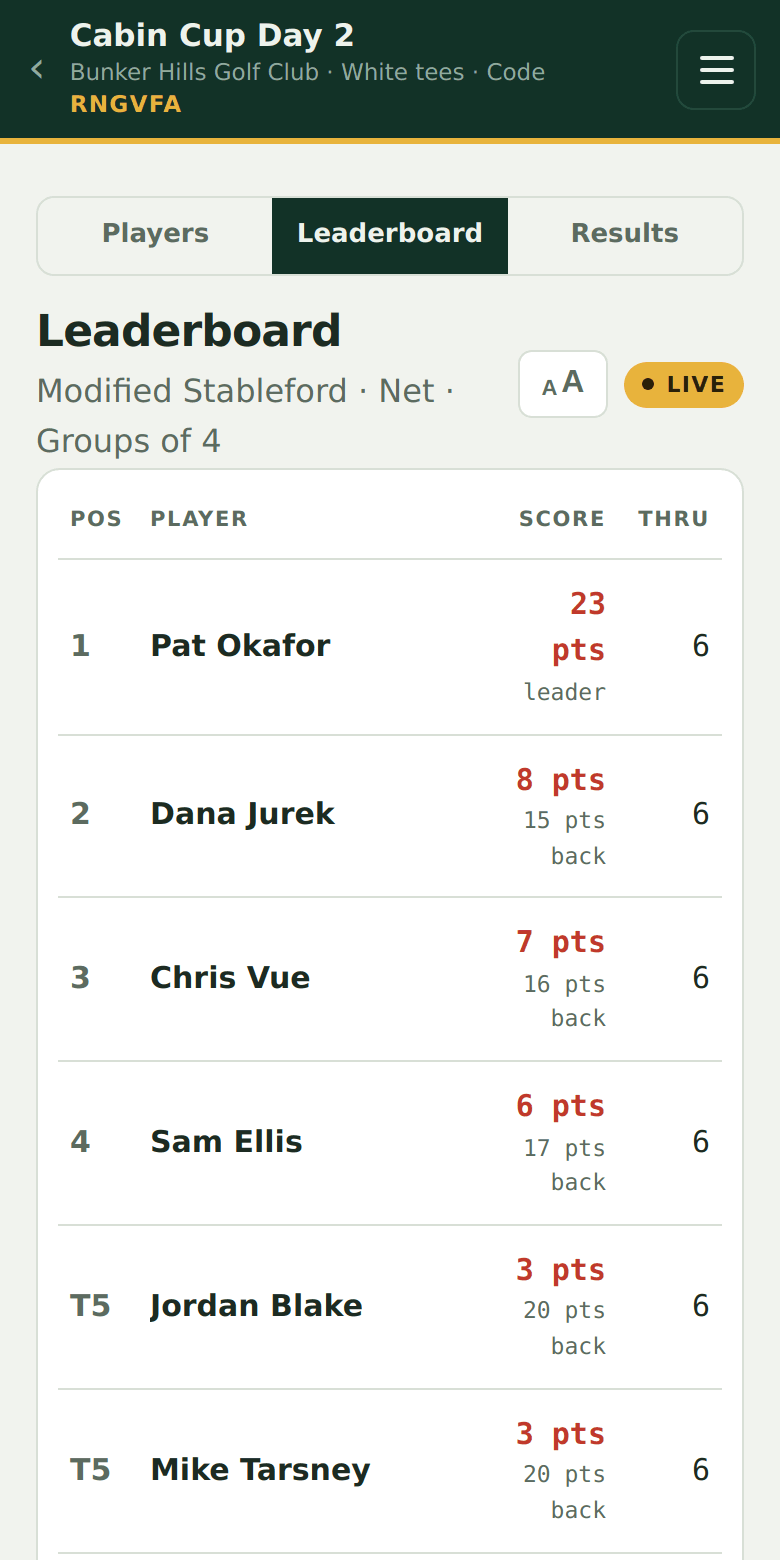
Modified Stableford is the aggressive professional cousin, best known from the PGA Tour's Barracuda Championship. The scale is stretched so that attacking is mathematically correct: albatross +8, eagle +5, birdie +2, par 0, bogey −1, double bogey or worse −3. Because a birdie gains more than a bogey loses, laying up is usually the wrong play - which is exactly the point.
For club and charity events, the standard 0-to-5 table is almost always the better choice: no negative numbers to explain, no math that punishes beginners. But a modified scale is a fun wrinkle for a low-handicap flight or a buddies-trip day where you want fireworks.
Why organizers love Stableford
For an event organizer, Stableford solves three problems at once. Pace: the pick-up-at-zero rule keeps a full shotgun field moving in a way stroke play never does. Retention: high handicappers post a real, respectable-looking score - 31 points sounds a lot better than 103 strokes - so casual players actually come back next month. Fairness: net Stableford is self-leveling, and blow-up holes cannot destroy anyone's day, which keeps the leaderboard interesting to the very end.
It is the natural pick for member days, leagues, senior groups, and any individual-format event with a wide handicap spread. If your field would find pure stroke play demoralizing but a scramble too gimmicky, Stableford is the answer. Its close cousin, quota golf, runs the same idea with a personal point target instead of a handicap deduction.
Score it live
ScrambleBoard scores Stableford natively - points computed hole by hole with handicap strokes applied, gross or net, with flights if you want them. Players join by scanning a QR code (no app, no accounts), enter scores on their phones even without signal, and the points race updates live on every phone and the clubhouse TV. Printable score sheets, cart signs, and QR posters come straight from the event, and skins, closest-to-pin, and long-drive side games run alongside.
Frequently asked questions
How does Stableford scoring work in golf?
You earn points on each hole based on your score against par: 0 for double bogey or worse, 1 for bogey, 2 for par, 3 for birdie, 4 for eagle, 5 for albatross. In net Stableford your handicap strokes adjust par on each hole first. Highest point total wins the round.
What is a good Stableford score?
36 points means you played to your handicap - two points per hole. Anything above 36 beat your handicap. At a typical club Stableford, scores in the high 30s contend and low 40s usually win; 45 or more suggests either a career round or a handicap that needs a look.
When can you pick up in Stableford?
As soon as you can no longer score a point on the hole - once you are guaranteed a net double bogey or worse. Pocket the ball, take 0 for the hole, and move on. Picking up costs nothing compared to finishing out and is the main reason Stableford rounds play faster than stroke play.
What is Modified Stableford scoring?
A stretched points scale that rewards aggression, used at the PGA Tour's Barracuda Championship: +8 albatross, +5 eagle, +2 birdie, 0 par, −1 bogey, −3 double bogey or worse. Because a birdie gains more than a bogey loses, players are incentivized to attack every flag.
How do handicap strokes work in Stableford?
Your course handicap is spread across holes by stroke index: an 18-handicap gets one stroke per hole, a 9-handicap gets strokes on the nine hardest holes, a 27-handicap gets two strokes on the nine hardest. Points are scored against your net result, so a gross bogey with a stroke counts as par for 2 points.
Run your event without paper Players scan a code, claim their name, and score on their phones. The leaderboard updates on every phone and the clubhouse TV. No app to install.
Create a free tournamentRelated guides
Whether you're planning a charity scramble, a member-guest, or a Saturday money game, the format decides how the day feels. This guide covers every common tournament format and side game - what it is, how scoring works, and when to pick it - with a full rules article for each.
Quota golf gives every player a personal point target - a quota - based on their handicap, then pays out to whoever beats their number by the most. It is the house format at countless US clubs' member games and money games because it does something few formats manage: a 2-handicap and a 22-handicap can both win, on gross scores, with no strokes given on any hole. Here is how the point quota system works and how to run it.
A Stableford score sheet turns strokes into points hole by hole - and that conversion step is exactly where paper scoring goes wrong. This page gives you the sheet layout to recreate, the standard points scale to print on it, and a worked nine holes so your scorers can see the whole thing done correctly before the round starts.
Golf tournament handicaps are the single biggest lever an organizer has for keeping every player in the hunt. Get them right and a 22-handicap can beat a 4-handicap on a fair fight; get them wrong and half your field checks out by the turn. This guide covers net vs gross, the three kinds of handicap in the World Handicap System, the standard percentage allowances by format, and how strokes actually land on the scorecard.