 Scramble
Guides Tournament formats
Golf scramble rules: the complete guide
Golf scramble rules are simple at their core: everyone hits, the team picks the best shot, and everyone plays from there. That simplicity is why the scramble is the default format for charity events, corporate outings, and just about any tournament where half the field plays twice a year. This guide covers the standard rules, the variations organizers actually use, and the details - drops, minimum drives, handicaps, ties - that keep the day from turning into an argument.
How a scramble works, step by step
A scramble is a team format, usually played in teams of four. Every player on the team tees off on every hole. The team then compares the four drives and picks the one it likes best - usually the longest ball in a decent lie, but sometimes the safe one in the fairway. The other three balls are picked up.
Every player then plays a shot from the spot of the chosen ball. The standard rule is that each player places their ball within one club length of the selected spot, no nearer the hole, and in the same condition - if the chosen ball is in the rough, everyone plays from the rough; if it is in a bunker, everyone plays from the bunker. On the green, balls are placed within one scorecard length or a putter head of the marked spot.
The team repeats the pick-and-play process for every shot, including putts, until the ball is holed. Once one player makes the putt, the hole is over - the remaining players do not finish. The team records a single score for the hole.
- All four players tee off.
- The team selects the best ball; mark the spot before anyone lifts it.
- Everyone plays from within one club length of that spot, no closer to the hole, same condition (rough stays rough, sand stays sand).
- Repeat for every shot. On the green, place within a putter head of the mark.
- First ball in the hole ends the hole; write down one team score.
Four-person scramble rules and the minimum-drive rule
The classic four-person scramble has one well-known weakness: a team with one long hitter can ride that player's drive all day while the other three contribute nothing off the tee. The fix nearly every organizer uses is a minimum-drive rule - each player's tee shot must be used a set number of times during the round. The most common requirement is a minimum of two or three drives per player over 18 holes; three is the sweet spot for keeping everyone engaged without wrecking a team that has one genuine beginner.
If you use a minimum-drive rule, say so on the rules sheet and put a drive-tracking box on the scorecard, because teams that leave their weakest player's drives for holes 16 through 18 have a bad time. Smart teams burn the short hitter's drives early on par 3s and short par 4s, where the penalty for a modest tee shot is smallest.
Two other conventions worth writing down: a ball may not be moved out of a penalty area or out of bounds - if all four balls are unplayable, the team takes a one-stroke penalty and drops under the normal relief rules - and putts must be holed unless you explicitly allow gimmes inside a set distance.
Two-person scrambles and Texas scramble variants
A two-person scramble works exactly like the four-person version with half the firepower: both players tee off, pick the better ball, and both play from there. With only two shots to choose from, scores run three to six strokes higher than a four-person scramble on the same course, and individual skill matters much more - which is why two-person scrambles are popular for member events and league nights where you want a team format that still rewards good golf.
You will also hear the name Texas scramble. In most of the US the term is used loosely as a synonym for any scramble, but the traditional Texas scramble adds a requirement: each player's drive must be used at least four times (in a four-person team), baking the minimum-drive rule into the format itself. A Florida scramble (also called a step-aside or stand-aside scramble) adds a twist for stronger fields: the player whose shot is chosen sits out the next stroke, so the team plays three balls instead of four after every selection. It slows runaway teams noticeably.
For couples and member-guest events, also consider the Chapman system - a scramble cousin where both players hit, swap balls, then alternate shots in.
Full guide: Best ball vs scramble: what's the difference?
Mulligans, string, and other fundraiser extras
Charity scrambles almost always sell extras, and they live comfortably inside scramble rules because the team plays one ball anyway. Mulligans - a do-over on any shot - are the standard: sell them at registration for $5 to $10 each, cap them at two to four per player (or a team bundle), and state clearly whether they can be used on putts. A mulligan replays the shot from the same spot and the original ball is dead.
String is the other classic. Teams buy a length of string (a foot per dollar is common, capped at a few feet) and may move the ball by hand anywhere - out of a bad lie, or from the lip of the cup into the hole - cutting off string equal to the distance moved. When the string is gone, it is gone. Both extras raise real money without breaking the format, but publish exactly what is allowed before the shotgun so every team plays the same game.
Full guide: Mulligans in golf tournaments: selling, pricing, and house rules
Scramble handicaps: the 25/20/15/10 allowance
Most charity scrambles are played gross with prizes by flight, and that is fine. If you want a net scramble, the USGA recommendation is to take a percentage of each player's course handicap, scaled by how much that player's ball is likely to be used. For a four-person scramble: 25% of the lowest handicap, 20% of the second lowest, 15% of the third, and 10% of the highest. Add the four results, round to the nearest whole number, and subtract that from the team's gross score.
For a two-person scramble the allowance is 35% of the lower handicap plus 15% of the higher. The percentages look stingy, but the team is playing the best of several balls on every shot - full handicaps in a scramble produce absurd net scores and guarantee the highest-handicap teams win.
| Team size | Allowance (low to high handicap) |
|---|---|
| 4-person scramble | 25% / 20% / 15% / 10% |
| 3-person scramble | 30% / 20% / 10% |
| 2-person scramble | 35% / 15% |
Full guide: Golf tournament handicaps explained
Tie breakers that hold up
Scrambles produce bunched leaderboards - a 12-under winner with three teams at 11-under is a normal day - so decide the tie breaker before play starts and print it on the rules sheet. The standard is a scorecard playoff on the handicap holes: compare the tied teams' scores on the number 1 handicap hole, then the number 2, and so on until the tie breaks. A common alternative is back nine, then last six, last three, then the 18th.
Whatever you choose, the two rules that matter are: publish it in advance, and never break a tie for real money with a coin flip. If you have daylight and the course cooperates, a live chip-off or putt-off for first place is a great show for the crowd at the clubhouse - but have the scorecard method as the fallback.
Score it live
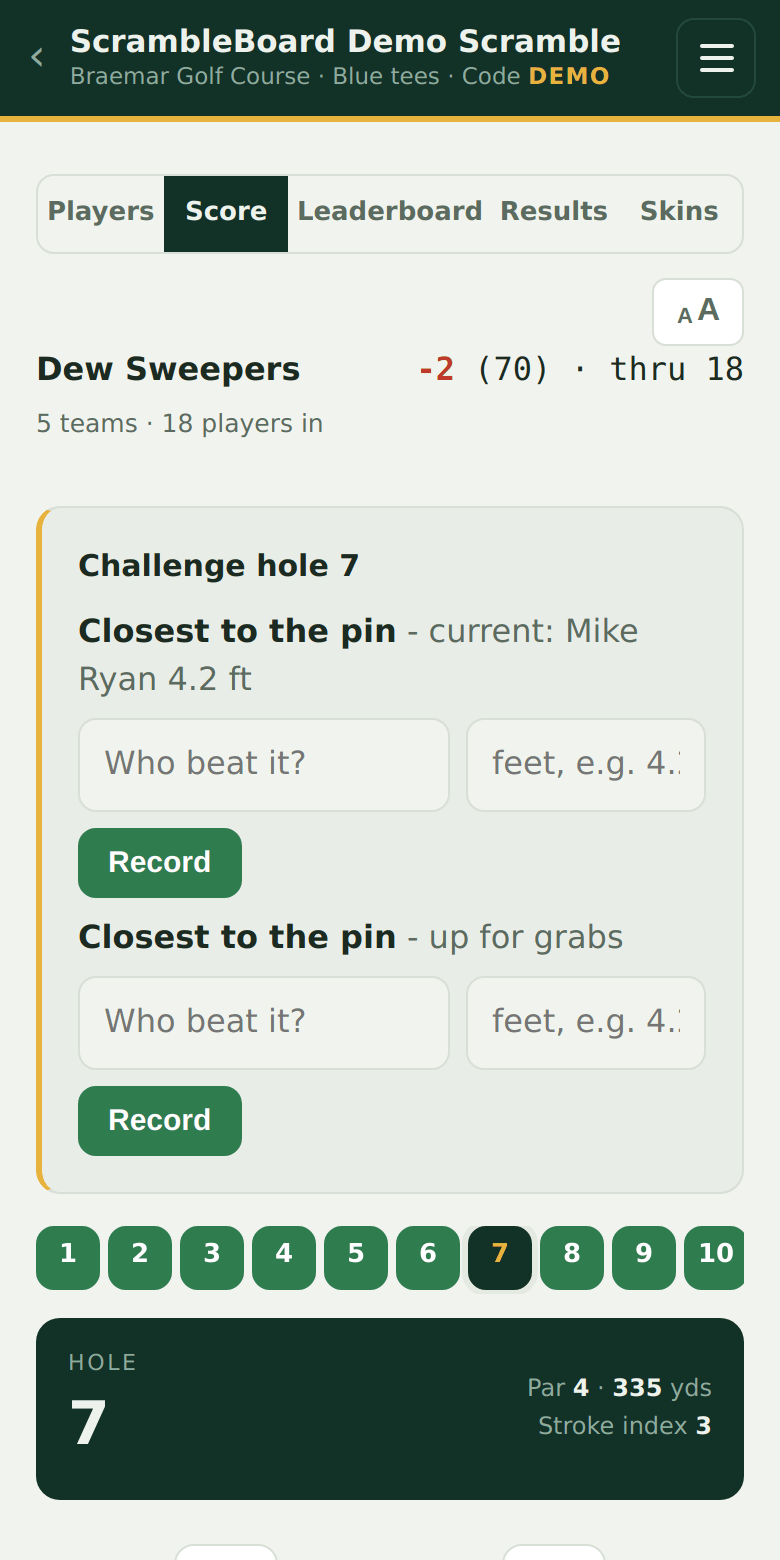
ScrambleBoard was built for exactly this event. Set up your scramble, print QR-code cart signs and scorecards, and every team joins by scanning - no app to install, no accounts. One player enters the team score each hole (it works even when the back nine has no signal), and the live leaderboard updates on every phone and the clubhouse TV, with gross or net scoring, flights, and skins, closest-to-pin, and long-drive side games tracked alongside.
Frequently asked questions
What are the basic rules of a golf scramble?
All team members tee off, the team picks the best shot, and everyone plays from within one club length of that spot (no nearer the hole, same condition). Repeat until the ball is holed and record one team score. Most events also require each player's tee shot to be used two or three times.
How many drives does each player have to use in a scramble?
There is no official rule - it is up to the organizer. The most common requirement is two or three drives per player over 18 holes in a four-person scramble. A traditional Texas scramble requires four. Print the requirement on the rules sheet and give teams a way to track it.
Can you move the ball out of the rough in a scramble?
No. The standard rule is that every player plays from within one club length of the chosen spot in the same condition - rough stays rough, sand stays sand. The exception is string, if your event sells it, which lets a team move the ball by hand at the cost of string length.
What is a good score for a four-person scramble?
On a typical par-72 course, a competitive charity-scramble team shoots 10 to 14 under gross, and 15 to 18 under often wins when teams are strong or extras like mulligans and string are in play. A casual team of average golfers usually lands between 2 and 8 under.
How do handicaps work in a scramble?
Use the USGA-recommended allowance: 25% of the lowest course handicap plus 20%, 15%, and 10% of the next three, summed, rounded, and subtracted from the team gross. Two-person teams use 35% and 15%. Full handicaps massively over-reward high-handicap teams.
Run your event without paper Players scan a code, claim their name, and score on their phones. The leaderboard updates on every phone and the clubhouse TV. No app to install.
Create a free tournamentRelated guides
Whether you're planning a charity scramble, a member-guest, or a Saturday money game, the format decides how the day feels. This guide covers every common tournament format and side game - what it is, how scoring works, and when to pick it - with a full rules article for each.
Best ball vs scramble is the most common format question tournament organizers ask, because the two get mixed up constantly - even by golfers who have played both. The short version: in a scramble the team plays one ball together; in best ball everyone plays their own ball and the team counts the best individual score on each hole. Which one you pick changes pace of play, difficulty, and who can realistically win.
A four-person scramble is the friendliest tournament format for an outing: everyone contributes, nobody gets embarrassed, and play stays fast. Here's how to run one end to end.
A golf scramble scorecard template is simpler than a regular card, because a scramble produces exactly one number per hole: the team score. The mistake most organizers make is handing out standard course scorecards with 18 columns and 4 name rows, then wondering why half the cards come back unreadable. Here is the layout that works, ready to recreate.