 Scramble
Guides Tournament formats
Best ball vs scramble: what's the difference?
Best ball vs scramble is the most common format question tournament organizers ask, because the two get mixed up constantly - even by golfers who have played both. The short version: in a scramble the team plays one ball together; in best ball everyone plays their own ball and the team counts the best individual score on each hole. Which one you pick changes pace of play, difficulty, and who can realistically win.
How a scramble works
In a scramble, every player on the team tees off, the team picks the best of the tee shots, and all players hit their next shot from that spot. The process repeats - pick the best ball, everyone plays from there - all the way into the hole. The team records a single score, and it is usually a good one, because the team gets multiple tries at every shot.
The scramble is forgiving by design. A topped drive or a chunked wedge simply gets discarded, which is exactly why it dominates charity and corporate golf: a 30-handicapper can play all day without ever costing the team a stroke, and every foursome posts a score that looks respectable on the leaderboard. Typical winning scores run 12 to 18 under par. Most events add a minimum-drive rule (each player's tee shot must be used two or three times) so the long hitter does not carry the team off every tee.
Full guide: Golf scramble rules: the complete guide
How best ball works
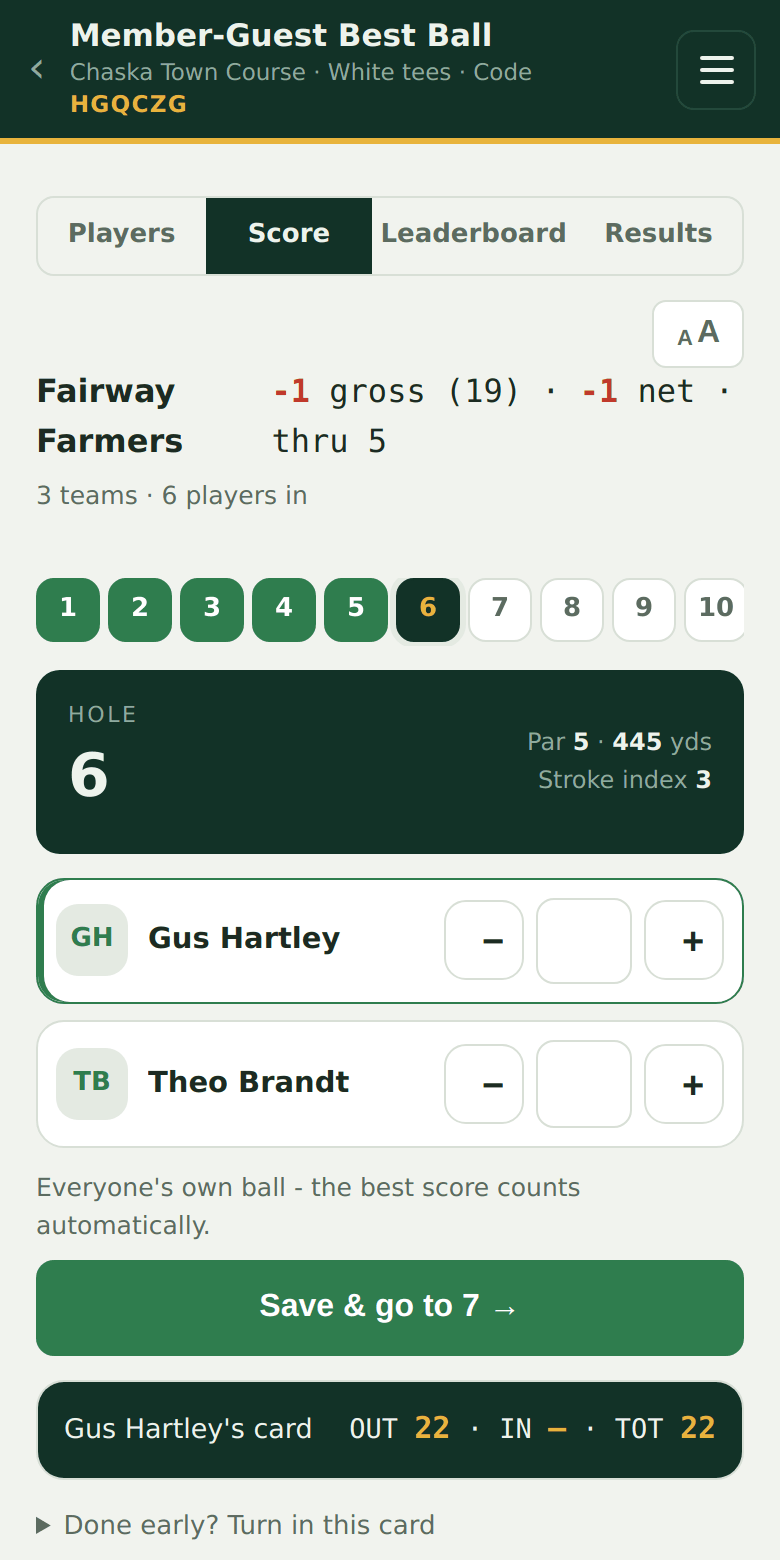
In best ball, every player plays their own ball from tee to green on every hole, exactly as they would in a normal round. At the end of the hole, the team's score is the best individual score among its players. If your foursome makes 4, 5, 5, and 7, the team writes down 4 and moves on. (When handicaps are used, it is the best net score that counts.)
Best ball is a real test of individual golf with a team safety net. Your bad holes get erased by a partner's par, but somebody on the team has to actually make that par - there is no collective ball to hide behind. It is the standard format for member events, leagues, and better-ball club competitions, usually in two-person teams (where it overlaps with four-ball, the official USGA term for two-player best ball). Four-person best ball, sometimes with the best two scores counting, is common for larger outings that want more golf than a scramble offers.
Best ball vs scramble at a glance
Here is the side-by-side that settles most planning debates.
| Question | Best ball | Scramble |
|---|---|---|
| Everyone plays their own ball? | Yes, from tee to hole | No - the team plays one chosen ball |
| Best score counts per hole? | Yes, best individual score | The single team score counts |
| Everyone tees off? | Yes | Yes, then the best drive is chosen |
| Handicaps used? | Yes, typically 85-90% net per player | Optional; reduced team allowance (25/20/15/10%) |
| Popular for charity events? | Sometimes | The default charity format |
| Difficulty for beginners | Hard - you play every shot yourself | Easy - bad shots are simply discarded |
When to pick which format
Pick a scramble when the field is mixed or unknown - charity events, corporate outings, anything where sponsors are buying foursomes and you cannot vouch for anyone's golf. It is faster than you would expect for four tee shots per hole (only one ball is ever in play after the pick), it keeps beginners comfortable, and it produces the festive low-score leaderboard fundraisers want. It is also the format that best absorbs sold extras like mulligans and string.
Pick best ball when the field consists of actual golfers who want to play their own ball - member tournaments, league play, buddies-trip competition. With handicaps applied it gives everyone a genuine chance while still rewarding good individual golf. Be honest about pace: four players finishing out every hole is slower than a scramble, so best ball works best with an established field, not 144 once-a-year players on a shotgun.
A practical middle ground for big outings: scramble on the front nine, best ball (or one-best-ball-of-four) on the back, or a 1-2-3 best ball where one score counts on par 3s, two on par 4s, and three on par 5s. Both keep everyone's ball relevant without the full grind of stroke play.
Run either one without paper
ScrambleBoard scores scrambles, best ball, and stroke-play events (gross and net, with flights) on a live leaderboard that updates on every phone and the clubhouse TV. Players join by scanning a QR code - no app, no accounts - and scoring keeps working even where the course has no signal. Skins, closest-to-pin, and long-drive side games run alongside, and you can print scorecards, cart signs, and QR posters straight from the event.
Frequently asked questions
Is best ball the same as a scramble?
No. In a scramble the whole team plays one ball - everyone hits from the spot of the best shot. In best ball every player plays their own ball for the entire hole and the team counts the best individual score. They are the two most commonly confused formats in golf.
Which is easier for beginners, best ball or scramble?
A scramble, by a wide margin. A beginner's bad shots are simply not used, so they never cost the team a stroke. In best ball a beginner must play every shot of every hole themselves, which is slower and can be discouraging on a hard course.
Is best ball faster or slower than a scramble?
Slower. In a scramble only one ball is in play after each pick, and the hole ends when the first putt drops. In best ball all four players finish (or pick up once they cannot beat the counting score), which adds real time per hole. Encourage picking up to keep best ball moving.
What is a good score in best ball vs a scramble?
In four-person best ball with mid-handicap players, a few under par gross is a strong team round, and winning net scores often reach 10 to 14 under. A four-person scramble on the same course typically wins at 12 to 18 under gross, because the team gets multiple tries at every shot.
Do handicaps work differently in best ball and scramble?
Yes. Best ball applies a percentage of each player's own course handicap (commonly 85-90%) and counts the best net score per hole. A scramble uses a small combined team allowance - typically 25/20/15/10% of the four handicaps from low to high - because the format itself already flattens skill differences.
Run your event without paper Players scan a code, claim their name, and score on their phones. The leaderboard updates on every phone and the clubhouse TV. No app to install.
Create a free tournamentRelated guides
Whether you're planning a charity scramble, a member-guest, or a Saturday money game, the format decides how the day feels. This guide covers every common tournament format and side game - what it is, how scoring works, and when to pick it - with a full rules article for each.
Golf scramble rules are simple at their core: everyone hits, the team picks the best shot, and everyone plays from there. That simplicity is why the scramble is the default format for charity events, corporate outings, and just about any tournament where half the field plays twice a year. This guide covers the standard rules, the variations organizers actually use, and the details - drops, minimum drives, handicaps, ties - that keep the day from turning into an argument.
Four-ball is the official term for the format most American golfers call best ball: two-player teams, everyone plays their own ball, and the better score of the two partners counts on each hole. The name confuses people every Ryder Cup - it refers to the four balls in play in a two-versus-two match, not to four-person teams. Here is what four-ball actually means, how it is scored, and how to handicap it.
Golf tournament handicaps are the single biggest lever an organizer has for keeping every player in the hunt. Get them right and a 22-handicap can beat a 4-handicap on a fair fight; get them wrong and half your field checks out by the turn. This guide covers net vs gross, the three kinds of handicap in the World Handicap System, the standard percentage allowances by format, and how strokes actually land on the scorecard.