 Scramble
Guides Side games & betting
What is a skins game in golf? Rules, carryovers, and examples
A skins game is the most popular side game in golf: every hole is worth a prize called a skin, and the only way to win it is to beat everyone outright. If two or more players tie for low score, nobody wins and the skin carries over to the next hole, where the pot gets bigger. That simple rule set is why skins shows up everywhere from Saturday foursomes to 144-player charity scrambles.
What a skins game is
In a skins game, each hole stands alone as its own contest. Before the round, every player (or team) puts an equal amount into the pot - say $5 each - or agrees on a per-skin value, like $2 a skin. Each of the 18 holes is worth one skin. Whoever wins the most skins takes the biggest share of the money, and a hot stretch of three or four holes can flip the whole game.
Skins is fundamentally different from stroke play. Your total score for the round is irrelevant - you can shoot the worst 18-hole score in the group and still cash if you made the only birdie of the day on a hole everyone else bogeyed. That hole-by-hole reset is exactly what makes skins so popular with mixed-ability groups: one great swing wins real money, and a blow-up hole costs you nothing beyond that hole.
Skins works as a game inside almost any other format. Foursomes play it on top of their regular match, leagues run a weekly skins pot, and tournament organizers layer a skins game over a stroke-play or scramble event as an optional buy-in.
How skins are won: outright low score only
The core rule of golf skins is that a skin must be won outright. The lowest score on the hole wins the skin only if no one else matches it. A lone birdie against three pars wins. A lone par against three bogeys wins just the same - the skin doesn't care how pretty the score was, only that it stood alone.
If two players tie for the low score, the hole is halved and nobody wins - even if the other two players made triple bogey. In most groups the standard rule is "a tie kills the hole": once two players have matched the current low score, the skin is dead for everyone (though see the validation variation below, which some groups use instead).
- Lowest score wins the skin - but only if it's unmatched.
- Any tie for low score means no skin is awarded on that hole.
- Every player is always live on every hole, no matter their 18-hole total.
- Skins can be played gross (raw scores) or net (with handicap strokes - see below).
Carryovers explained
Carryovers are what turn a casual skins game into drama. When a hole is tied and no skin is won, that skin carries over: the next hole is now worth two skins. Tie again and the following hole is worth three. Long carryover chains are common - it's entirely normal for a group of similar players to halve five or six straight holes, and suddenly a short par 3 is worth a third of the entire pot.
Two details are worth agreeing on before the first tee. First, what happens to skins still carrying after 18? The common answers are: they roll into the total pot and get split by skins won, they're settled by a playoff hole, or they simply vanish (rare, and nobody likes it). Second, confirm the carryover rule itself - some groups play no-carryover skins, where a tied hole's money just returns to the pot rather than loading up the next hole.
Worked example: four players, six holes
Here's how a $2-per-skin game plays out for Al, Ben, Cal, and Dee over the first six holes. Watch how the carryovers stack.
| Hole | Scores (Al / Ben / Cal / Dee) | Result |
|---|---|---|
| 1 | 4 / 4 / 5 / 5 | Al and Ben tie at 4 - no skin, carries over |
| 2 | 5 / 4 / 4 / 6 | Ben and Cal tie at 4 - no skin, 2 skins now carrying |
| 3 | 3 / 4 / 4 / 5 | Al's lone birdie wins 3 skins ($6) |
| 4 | 4 / 5 / 4 / 4 | Three-way tie at 4 - no skin, carries over |
| 5 | 5 / 5 / 6 / 4 | Dee's lone 4 wins 2 skins ($4) |
| 6 | 4 / 3 / 5 / 4 | Ben's birdie wins 1 skin ($2) |
Net skins: playing with handicaps
Gross skins heavily favors the best player, so most mixed groups play net skins. Each player takes their handicap strokes on the holes where they fall, using the stroke index (handicap row) on the scorecard. A 12-handicap gets one stroke on each of the 12 hardest holes; on those holes their 5 counts as a net 4 for skins purposes.
Two common refinements keep net skins fair. Many groups play off the low handicap - the best player plays at scratch and everyone else takes the difference, which trims the total strokes in play. And in large-field events, organizers often cap strokes (for example, at one per hole, ignoring second strokes for 19-plus handicaps) so a very high handicap can't win a pile of skins with net eagles. Whatever you choose, announce it before the round; net-skins arguments are the most common skins arguments there are.
Common variations
- Validation skins: winning a skin isn't final until you "validate" it by at least tying the low score (or making par) on the next hole. Fail to validate and the skin carries instead. Adds pressure; adds bookkeeping.
- No-carryover skins: tied holes are simply dead and the money returns to the pot, which is then divided by skins actually won. Keeps every hole at equal value.
- Whole-field skins: the tournament version. Every entrant in a 100-player event is in one pot, and a skin needs an outright low score against the entire field - usually only two to four skins survive across 18 holes, so each one pays big.
- Back-nine double: skins on holes 10-18 are worth two, so nobody's dead money at the turn.
- Team skins: in scrambles or four-ball events, the team score competes for the skin - same rules, one line per team.
Running skins at a tournament
For an organized event, skins is usually an optional cash buy-in ($10-$20 per player is typical) kept separate from the entry fee, with 100% of the skins pot paid back out. Decide gross or net (or run both pots), publish the tie and carryover rules on your rules sheet, and settle up as soon as scores are final. The classic failure mode is finding a scoring discrepancy after the skins money has been paid - which is a good argument for live scoring over paper.
Full guide: Printable skins scorecard
Track it live
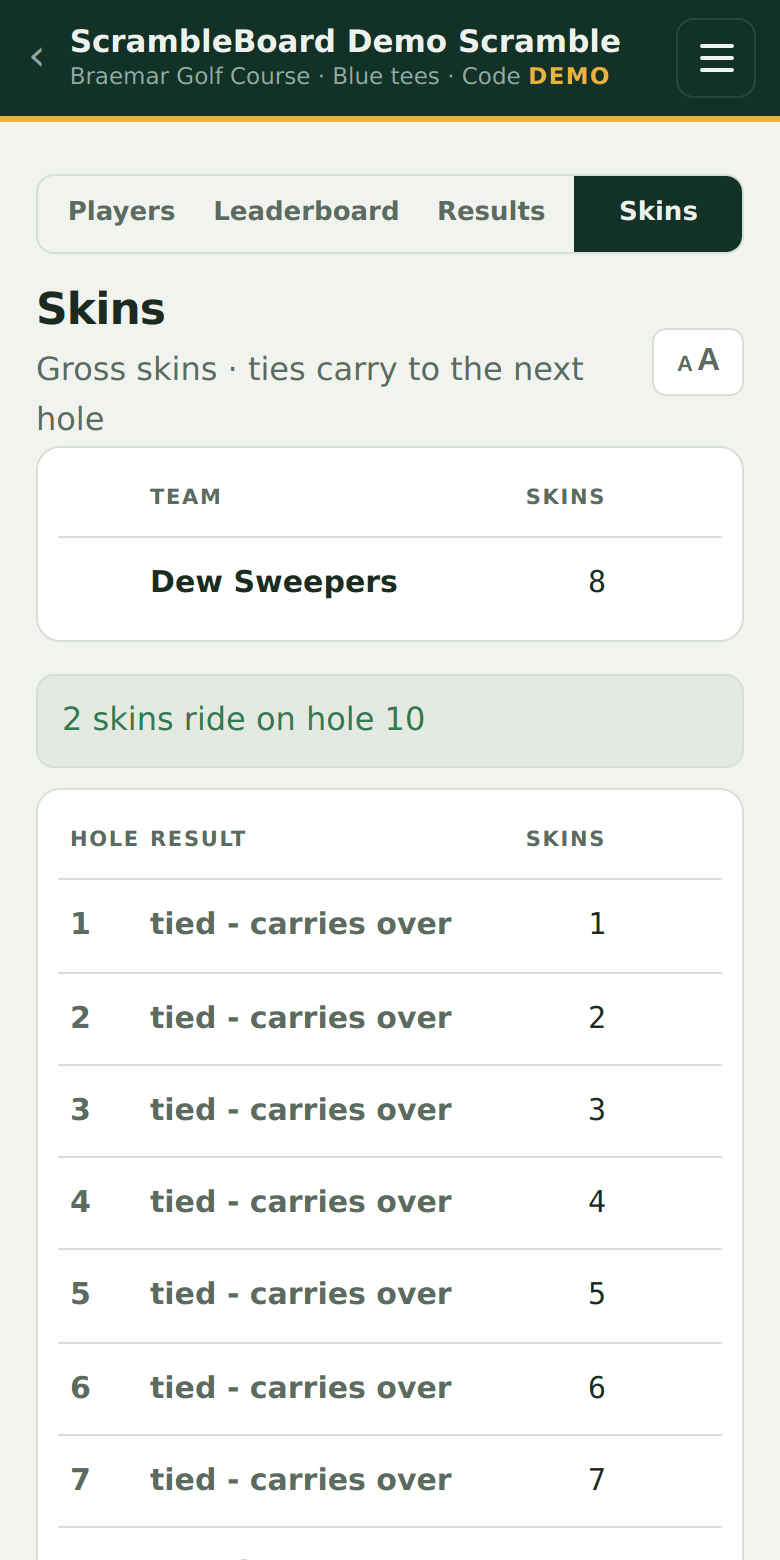
Skins is built into ScrambleBoard. Run your event in scramble, stroke play, or Stableford, gross or net, and the skins game scores itself hole by hole from the same numbers players are already entering - carryovers and all - alongside built-in closest-to-the-pin and long-drive contests. Players join by scanning a QR code (no app, no accounts), scores sync even when the course kills your signal, and the live leaderboard runs on every phone and the clubhouse TV. You can also print scorecards, cart signs, and posters straight from the event.
Frequently asked questions
How do golf skins work with 4 players?
All four players compete on every hole. The lowest score wins the skin only if no one matches it; any tie for low score means the skin carries over to the next hole. At the end of 18, the pot is divided by skins won.
What happens if you tie a hole in skins?
Nobody wins the skin. In standard skins the value carries over, so the next hole is worth two skins; in no-carryover skins the tied hole's money simply returns to the pot.
How much money do you play skins for?
Most weekend games run $1-$5 per skin or a $5-$20 buy-in per player, and tournament skins pots are usually a $10-$20 optional add-on. Keep the stakes at whatever your group can laugh about afterward - skins is a social game, not a casino.
Can you play skins with handicaps?
Yes - that's net skins. Players take their handicap strokes on the holes indicated by the scorecard's stroke index, usually playing off the low handicap in the group, and the lowest unmatched net score wins the skin.
What are skins worth if nobody wins the last hole?
You decide before the round: most groups either roll unclaimed carryovers into the overall pot (splitting by skins won), or settle leftover skins with a playoff hole.
Run your event without paper Players scan a code, claim their name, and score on their phones. The leaderboard updates on every phone and the clubhouse TV. No app to install.
Create a free tournamentRelated guides
Whether you're planning a charity scramble, a member-guest, or a Saturday money game, the format decides how the day feels. This guide covers every common tournament format and side game - what it is, how scoring works, and when to pick it - with a full rules article for each.
A printable skins scorecard needs one thing a normal card does not: a place to track carryovers. In a skins game, a tied hole pushes its value to the next hole, and by hole 14 nobody at the table remembers whether three skins or four are riding. This page gives you the exact layout to recreate, a worked example, and the settlement table for the end.
The Nassau is the most played golf bet in America: three separate bets in one round - the front nine, the back nine, and the overall 18. A "$5 Nassau" means each of those three bets is worth $5, and the press rule lets a losing side start new bets mid-round, which is where all the fun (and all the arguments) come from.
Wolf is a four-player golf game where the teams change on every hole. One player - the Wolf - watches the other three hit their drives and decides, shot by shot, whether to take a partner or go it alone for double points. It's the best game in golf for groups that want strategy and table talk, not just scorekeeping.